
Mahdaviyat Lecture Series: Raising a Mahdavi Generation (Session 9) | The Concept of Intizar and Its Interrelation with Power and Politics
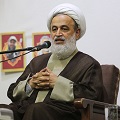
Lecture Series on Mahdism: Raising a Mahdi-Oriented Generation, Session 5
The Concept of Awaiting (Intizar) and Its Relation to Power and Politics
Information:
- Date: October 18, 2024
- Venue: Great Fatimiyyah of Tehran – Hay'at Muhibban Mawla Amir al-Mu'minin (a)
- Topic: Raising a Mahdi-Oriented Generation (Knowing Imam Mahdi (aj) and Understanding the End Times)
- Audio: Here
Attaining a Blessed End: The Constant Concern of the Awliya’
Islam is an authentic and profound religion, and whether our deeds are accepted remains hidden from us. For this very reason, one of the primary concerns of the Awliya’ (the intimate friends of God) has always been attaining a blessed end and leaving this world with intact faith. There is a narration stating that when the Holy Prophet (s) informed Imam Ali (a) of his future martyrdom, the Imam’s immediate concern was his spiritual end, asking the Messenger of Allah (s): “Will my faith remain intact at that moment?” (Manaqib al-Imam Amir al-Mu’minin, vol. 2, p. 551). This is a remarkably profound statement. Even though he is the “Distributor of Heaven and Hell” (Qasim al-Jannah wa an-Nar), he still expresses such genuine concern for his final outcome in faith.
The True Fruit of Religiosity Manifests in Awaiting the Imam
Religion is a complete framework comprising faith in God, God-wariness (taqwa), devotion to Wilayah, and similar virtues. God, too, looks at human capacity. Consider the entirety of your religious life—from faith to righteous deeds, from piety to Wilayah, and from charity to worship—has its ultimate fruit been the deepening of your sense of awaiting (intizar), or not? Has it made you truly yearn for the Advent (Zuhur)? Has it led you to long for the Imam’s presence, or not? If the fruit of your religiosity manifests in awaiting the Imam, then your faith is genuine. This is a fundamental question. A person cannot claim true religiosity while its very essence and ultimate criterion is not a living bond with the Imam of the Age (aj), or if one fails to perceive him behind the veil of occultation and lacks a spiritual connection with him. Everyone must examine themselves. When you recite the supplication “Allahumma kun li-waliyyik al-Hujjah…”, what do you truly feel? How much importance and devotion do you invest in this prayer? In the countries along the Axis of Resistance, people routinely recite this prayer in their Qunut.
Our Bond with Imam Mahdi (aj): An Inward and Heartfelt Recognition
Another crucial point here is our profound longing for the Advent. How does this sense of awaiting—for which such immense reward has been promised—become tangible? Where does it demonstrate itself? One of the challenges of our era is precisely this intangible, imperceptible condition we experience. The closer we get to the End Times, the more faith becomes cognitive, intellectual, and deeply rooted in contemplation rather than merely sensory or emotional. For instance, we believe in an Imam who assumed the Imamate at five years of age and entered occultation at that very time. After a period of the Minor Occultation, the Major Occultation commenced. How are we to establish a connection with an Imam who, over a millennium of history, has not had direct physical interactions with the public? Through inward recognition and spiritual insight of the heart (ma'rifah qalbiya). It is under these exact circumstances that we must build our living connection with the Imam of the Time (a).
For instance, if we wish to connect with Imam Hussain (a.s.) and the event of Ashura, the day of Ashura, Arbaeen, numerous historical accounts, the exalted land of Karbala, and the like—these are all tangible means that connect us with his noble persona. But if you wish to connect with the Guardian of the Age, Imam al-Mahdi (a.j.), it becomes entirely, or predominantly, an affair of the heart. You must resolve within yourself how to establish your bond with him: through Ziyarat Al Yasin, Du‘a al-Nudbah, or Du‘a al-Ahd. These will become the sacred sanctuary of your communion with him; or perhaps amidst life’s unfolding events, you yourself create an occasion to remember the Imam of the Time (a.j.). The crux of the matter is that we must be deeply attuned and sensitive to his reappearance, and this sensitivity must manifest itself somewhere in our lives.
The Key Criteria of True Religiosity
1. Love for Allah;
Allah Almighty states in the Holy Quran: “And those who believe are stronger in their love for Allah” (Al-Baqarah, 165). Those who possess faith hold the most intense and profound love for Allah. This is presented as an essential criterion of faith, and an exceedingly prominent one at that. That is to say, whoever possesses genuine faith is deeply in love with God and loves Him far more than anything else in life.
2. Prioritizing the Command of the Messenger (s.a.w.);
Another criterion of true religiosity is that when a command from the Messenger of Allah (s.a.w.) arrives, one casts all other preoccupations aside. The Holy Quran states: “The believers are only those who believe in Allah and His Messenger, and when they are with him on a matter of collective importance, they do not depart until they have asked his permission. Indeed, those who ask your permission are the ones who believe in Allah and His Messenger. So when they ask your permission for some of their affairs, give permission to whom you will among them and ask forgiveness for them from Allah. Indeed, Allah is Forgiving and Merciful” (An-Nur, 62). True believers are solely those who, when the Messenger of Allah summons them to a collective matter of vital importance, do not leave his presence or step outside the light of his command unless they seek his permission... This Quranic verse illustrates that a true believer is one who prioritizes the command of the Prophet above his entire life, above all his endeavors and everyday concerns. A true believer, in reality, eagerly awaits the command of the Imam of the Time (a.j.), and this is set forth as a defining criterion.
3. Awaiting the Reappearance (Intizar);
The third criterion of religiosity is awaiting the reappearance of the Imam of the Time (a.j.). The ultimate benchmark of whether we are genuinely religious is this very state of awaiting (Intizar). The measure is our inner devotion toward the Imam of the Time and our heartfelt longing for his advent. The Commander of the Faithful, Imam Ali (a.s.), said: “The one who awaits our cause is like one who rolls in his blood in the way of Allah” (Kamal al-Din, 645). One who eagerly awaits our advent, who awaits our divine governance, is akin to a martyr soaked in his own blood in the path of Allah! Many might wonder in astonishment: 'Merely awaiting?! Can this state of anticipation alone elevate a person to the exalted rank of martyrdom?!' You may indeed be astonished, but know that Intizar is the very essence of our religiosity and the true touchstone of the integrity of our faith. We might possess a certain degree of belief, yet the Quran may not address us as true 'believers' (Mu’min)! We must all recognize this reality: merely believing in God does not necessarily make one a true believer. Even the disbelievers and polytheists held a belief in God (Az-Zumar, 38), but according to the Quranic verse, one may hold a concept of belief without being a true Mu’min. We too may believe conceptually, yet lack true faith. Where does the difference become apparent? In our awaiting (Intizar). Each person according to their own capacity, each according to their own measure. But this profound longing must be visibly reflected somewhere in our lives.
Proving Our Awaiting by Raising a Mahdi-Centered Generation
One of the finest realms in which we can demonstrate our deep devotion to the Guardian of the Age (a.j.), our sensitivity to his occultation, and our earnest longing for his reappearance, is in the upbringing of our children. It lies in raising a generation that aspires to be Mahdi-centered—a generation that genuinely lives in anticipation. Here, the immediate timing of the reappearance is not the primary issue. Even if the reappearance were far off, you must still raise a generation of true anticipators (Muntazirin). It is not enough to merely raise a 'believing' generation; we must be vigilant never to succumb to a secularized form of religiosity.
You could raise the next generation spiritually without considering the concept of awaiting (*intizar*) and deliverance (*faraj*), without considering living in the service of Imam Mahdi (aj), and without preparing the ground for his advent. One could view oneself this way, and indeed there are many who study, who teach, and even teach spiritual subjects, yet there is virtually no trace of Imam Mahdi (aj) or awaiting the deliverance in their conduct and way of life.
The Station of the Awaiting Believer in the Words of Imam al-Baqir (a)
Imam al-Baqir (a) states: "Whoever among you recognizes this matter [our rightful governance], awaits it, and anticipates good through it, is, by God, like someone who fights alongside the Qa’im of the Family of Muhammad (s) with his sword" (Tafsir al-Safi, vol. 5, p. 136). That is, whoever among you recognizes this cause, believes in it, awaits it, and regards all goodness to lie within it, is—by God—like one who strives alongside the Qa’im of the Family of Muhammad (s) with his sword.
Imam al-Baqir (a) expresses these words while he himself is present, and yet he encourages those around him to eagerly await our governance. When you strive for the cause of the Ahl al-Bayt (a) and for the establishment of the Islamic Ummah, you are striving to alter the course of human history and to set in place that eternal, luminous path for human life. Thus, awaiting is an immensely significant matter.
What Is the Meaning of Awaiting?
What is awaiting deliverance (*intizar al-faraj*)? Imam Khomeini (ra) explained it in a single sentence: "Awaiting deliverance is awaiting the power of Islam" (Sahifeh-ye Imam, vol. 8, p. 374). This means you must eagerly await Islam gaining power. Islam must become powerful, and Muslims must become powerful. Is it possible for us to believe in the Messenger of Allah (s) yet not await the empowerment and authority of the Messenger of Allah (s)? Naturally, had we lived in the era of the Messenger of Allah (s), we would have understood what the core orientation of religion was in the eyes of the Prophet (s)—namely, securing power for the Messenger of Allah (s) and consolidating his authority. Had we lived in the era of the Imams of Guidance (a), we would have felt their profound isolation and oppression. If we possessed true sensitivity and fervor toward the isolation of the Imams of Guidance (a), we would eagerly await their cause.
What Is the Power of Islam?
The fact that the narrations instruct us to "Await our affair" means awaiting the governance of Imam Mahdi (aj) and his empowerment. Some people even now await Imam Mahdi (aj), yet they do not await the empowerment of Islam. What is the power of Islam?! Let me put it very simply for you. Imagine you are sitting beside Imam al-Baqir (a) and he asks you: "Are you awaiting our affair or not? Or do you merely believe in us? Are you awaiting our rule as well, or not? Or are you merely obedient? Or merely a lover? If we were to gain power one day, are you truly awaiting our cause?" Thus, the very essence of spirituality and religious devotion manifests itself in the political realm. That is, your relationship with God may be fine, your relationship with the Hereafter and Resurrection may be fine, your connection with the Ahl al-Bayt (a) and the divine prophets may be sound, you perform acts of worship, and your morals may be refined—yet your path never once crosses the realm of power and politics. These very things can turn into a distortion of religion.
Mahdaviyat Lecture Series: Raising a Mahdavi Generation (Session 9) | The Concept of Intizar and Its Interrelation with Power and Politics
Now Playing (1 / 1)
تربیت نسل مهدوی/ج۱۴
Your feedback on this article
Share your thoughts, suggestions, or comments regarding this article.