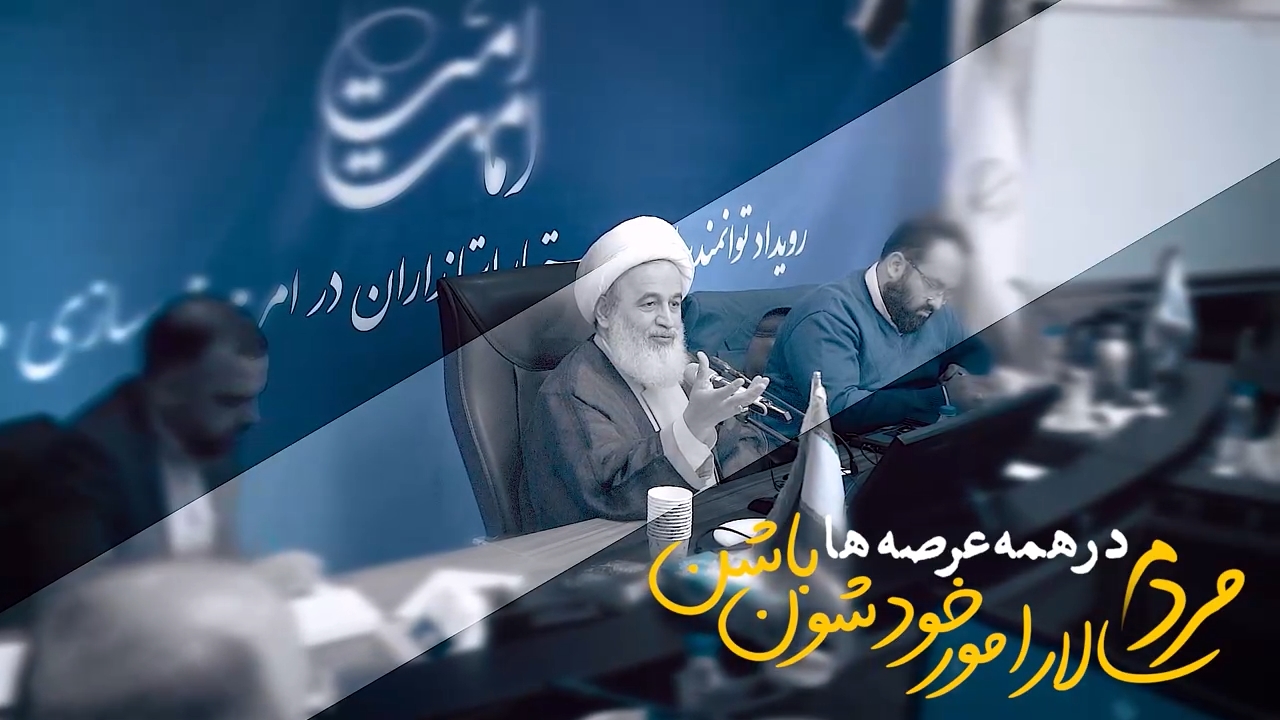
Zamana Program, TV2 – The Martyrdom of Sayyid Hassan Nasrallah (Sep 28, 2024) | In the Many Discussions Taking Place, Certain Spiritual Dimensions of Martyrdom Are Overlooked
Live Television Interview - IRIB TV2 - The Martyrdom of Sayyid Hassan Nasrallah
In many discussions taking place, certain spiritual dimensions of martyrdom are overlooked. The Holy Quran clarifies this matter very clearly in verse 156 of Surah Al-Imran, stating: "O you who have believed, do not be like those who disbelieved..." O believers! Do not be like the disbelievers. In what respect?
Information:
- Date: September 28, 2024 (1403/07/07)
- Venue: IRIB TV2, Zamaneh Program
- Subject: The Effects and Outcomes of the Martyrdom of Sayyid Hassan Nasrallah
The Necessity of Paying Attention to the Spiritual Dimensions of Martyrdom
In many discussions that take place, certain spiritual dimensions of martyrdom are overlooked. The Holy Quran clarifies the matter very clearly in verse 156 of Surah Al-Imran, stating: "O you who have believed, do not be like those who disbelieved..." O believers! Do not be like the disbelievers. In what respect? "...and said about their brothers when they traveled through the land or went out to battle, 'If they had been with us, they would not have died or been killed.'" Do not be like the disbelievers who say concerning their brothers: if they had remained with us and had not gone to the battlefield of Jihad, they would neither have died nor been killed.
God Almighty regards such a statement—saying that if so-and-so had not gone to Jihad, he would now be sitting safely beside us—as a disbelieving mindset; because death is in the hands of God. A person who embraces martyrdom has, in reality, chosen the manner of his own death. Of course, many issues must also be evaluated in their proper place; such as whether we could have fulfilled our duty better so that he would not be martyred. In this analysis, I do not intend to dismiss the role of the enemy or overlook possible faults and shortcomings. Likewise, the necessity of exacting revenge upon the enemy remains entirely valid and preserved in its place.
Even if we examine all those factors, martyrdom does not alter the appointed time of death. We must possess this inner peace. Would it not have been a pity if the death of this noble Sayyid had not culminated in martyrdom!? And if he had not left behind such profound and magnificent effects through his departure amidst such a glorious martyrdom!? God says that if you look exclusively at material causes and means and neglect the reality of divine decree regarding death and martyrdom, saying "If he hadn't gone to Jihad, he would still be alive," your words stem from disbelief. We must not look at it this way.
Regarding this chain of sixty-three-year-old martyrs—namely Sayyid Hassan Nasrallah, Ismail Haniyeh, Martyr Raeisi, and Haj Qasem, who were all sixty-three years old—one must say that there was truly a divine light within them, and indeed, this was the time of their natural death. In one part of our hearts, we find solace in divine decree; had he passed away due to an illness, for instance, would we have been happier? No; we must realize that the immense grace and merit they possess transforms their death from a natural one into martyrdom and bestows upon it magnificent consequences.
Ibn Abi al-Hadid narrates from the Commander of the Faithful, Imam Ali (peace be upon him), who said: "Whoever is not killed will still die." (Sharh Nahj al-Balaghah, Vol. 1, p. 306). Therefore, we carry out our assessments with composure and peace of mind. Of course, this inner peace does not mean we do not grieve. Aba Abdillah al-Hussain (peace be upon him) shed tears for the martyrs on the plains of Karbala, even while knowing he would join them just hours later. These tears have their place; investigating faults and shortcomings has its place; and this faith in the true meaning and divine dimension of martyrdom also has its place. This faith truly brings tranquility to a person and brings contentment to the heart.
The Effects and Outcomes of the Martyrdom of Sayyid Hassan Nasrallah
The martyrdom of Martyr Hassan Nasrallah also carries blessings that, had he passed away of natural causes, we might never have attained any of these blessings and profound results.
1. Promoting the Culture of Martyrdom
One of the hidden divine graces and blessed impacts of this martyrdom is the promotion of the culture of martyrdom. When Imam Khomeini (ra) accepted the UN resolution, he prayed: "May God not fold the banquet of martyrdom from among the lovers of martyrdom." The Imam did not pray for insecurity or for losing our youth and righteous individuals; the Imam believed in the reality of death and did not want all deaths to be merely natural deaths. The Imam wanted the highest level of security, yet alongside it, he also prayed for martyrdom.
The very first thing achieved by the martyrdom of this beloved figure was the dissemination of the culture of martyrdom. His immense popularity led to the spread of this culture. This culture of martyrdom is precisely what Rice, the former US Secretary of State, spoke of when she said that as long as these people teach the culture of martyrdom to their children, they are terrorists. Now, our foolish enemies have inadvertently strengthened this very culture. Some time ago, I traveled to Lebanon. On a Friday night at the martyrs' cemetery, I saw young people whom I never expected to be there at that late hour, yet it seemed to be their regular gathering place. Their prayer, their sole yearning, was martyrdom. This culture of seeking martyrdom is truly extraordinary.
2. The Destruction of the Trend of Compromise
Another crucial outcome is that the martyr Sayyid Hassan Nasrallah dismantled the approach of compromise and appeasement. How could one ever shatter the path of the appeasers? Only through the oppressed martyrdom of such an eminent figure. The blow dealt to compromise by his martyrdom could never have been struck by any other means. Let us never take compromise lightly.
When Prophet Moses (as) went for intimate communion with God, the Samiri turned those oppressed people—who had witnessed so many great miracles—into calf-worshipers. The Messenger of Allah (saw) said: "I, too, have a Samiri in my Ummah. The slogan of the Samiri of my Ummah is 'No fighting (lā qitāl)'" (Amālī al-Mufīd, p. 30); and this signifies sheer compromise and pacifism.
The compromiser constantly theorizes peace, yet never specifies when the time for Jihad arrives; he always disguises cowardice as prudence and expediency, yet never possesses the courage for Jihad or the bravery to fight in the way of Allah. Real peace cannot be attained without honorable struggle.
3. Understanding and Recognizing the Enemy
Gaining a profound perception and awareness of the enemy's nature is so challenging that God tells the Prophet (saw) in the Quran that some people cannot believe that certain individuals will remain in Hell forever. They ask: How monstrous could someone's crimes possibly be to deserve eternal torment?
Many believers fail to grasp the sheer depth of the enemy's malice. For instance, they imagine that if they lay down their weapons, the enemy will lay down theirs too; or that if they step back, the enemy will also step back. They presume there must still be a spark of humanity left in the enemy's heart that will move them to show mercy somewhere along the way—whereas the enemy shows absolutely no mercy. What else should God have done for us to truly recognize the enemy!?
In the event of Ashura, one of the reasons Imam Hussain (as) brought Ali al-Asghar (as) onto the battlefield was precisely to reveal the utmost wickedness and cruelty of the enemy. The mourning elegies (Rawdahs) are not only meant to instill the love of Imam Hussain (as) in our hearts, but also to awaken our awareness to the unmitigated evil of the enemy.
4. The Multiplication of Sayyid Hassan Nasrallah
When Sayyid Hassan Nasrallah began his struggle, he was a young seminary student without a single white hair in his beard. Today, we have countless seminary students like him. Let no one react with despair. Despair is one of the whisperings of Satan. Sayyid Hassan Nasrallah has been multiplied, and this is the divine tradition of martyrs.
We must never surrender our cognitive calculations to Satan. Our analytical framework falls into the hands of Satan whenever we assume that resistance carries a heavy cost. While resistance may entail costs, its price is incomparably lower than that of compromise. In compromise, there lies immense humiliation and prolonged suffering; whereas the cost of resistance can be sweet and rewarding, and it will undeniably yield dignity and honor.
The Cost of Compromise Is Far Higher than the Cost of Resistance
Let us believe that if it is our duty, we must stand against the Zionists. If we fear danger, we will fall into misery; we will suffer casualties and endure calamities. If God had willed, He could have left us without any enemies. God Himself has the power to annihilate our enemies. God says: “And thus We have made for every prophet an enemy—devils from among mankind and jinn” (Al-An’am, 112), because He wants to test us. Some people pray, “If only these enemies did not exist; if only they were destroyed on their own; if only we could escape this test and the enemy would back down,” and so forth. Such people suffer from a form of foolishness and have failed to comprehend even the most basic rules governing human existence.
In the thirty years following the Sacred Defense, extensive work was done on our society’s culture. Many believe that security can be attained through compromise and that this represents rationality. In reality, this is not the case at all. When war comes knocking at your door, if you shut the door, they will bring the ceiling down upon your head and bury you with humiliation under the darkness of history. Ayatollah Bahjat used to say: “If only our enemies would be satisfied with enslaving us and at least keep us alive as slaves.”
Let us truly believe that the cost of resistance is far less than the cost of compromise. Perhaps the worst kind of calculation leading to the destruction of Iran is for officials to say: “If we launch a missile at them, they will fire one back and, for example, set one of our gas stations on fire; so let us not strike.” The Supreme Leader once stated that resistance has costs, and compromise also has costs, but the cost of compromise is greater than that of resistance. This statement must be thoroughly analyzed. This is not merely a religious concept; it is an entirely rational thought. Today in our country, some say Israel is evil and vicious—meaning we ought to back down. Bring those who have studied history to explain this matter. The people who fled from the evil of Yazid ended up afflicted with Hajjaj ibn Yusuf al-Thaqafi, who slaughtered people without a trial. Whenever anyone had a dispute with someone, they would accuse them of being a lover of Ali ibn Abi Talib (a), and Hajjaj would then annihilate his entire lineage and family. The people of Medina used to say to Imam Hussain (a), “Back down just a little”; later, during the Event of Harrah, Yazid himself slaughtered seven hundred of the Companions and Successors in Medina, streams of blood flowed, and their sanctities and women were violated. Compromise is utterly terrifying. This is our great test.
The Duty of the Media and Political Figures to Raise the People’s Capacity for Resistance
Our greatest slogan today is “Death to compromise!” We must be prepared; whatever our true expediency is, we can discuss it. Sometimes, this very readiness alters our expediencies. At times, the Messenger of God (s) remained silent in the face of the hypocrites. When the hypocrites attempted to assassinate the Prophet (s), Hudhayfah asked, “Why do you not execute them?!” The Prophet pointed to the lack of readiness in public opinion and said that people would then say the Prophet executed his own companions; this meant the people lacked the necessary capacity.
The role of demonstrations, the media, and political figures is to elevate the people’s capacity. If a political figure is capable of declaring to the people—and indeed must consider it his duty to declare—that the cost of resistance is less than the cost of compromise, yet chooses silence, God will punish him in the lowest depths of Hell, because political figures guide and shape the people’s direction. What was Abu Musa al-Ash’ari saying that caused the Commander of the Faithful, Imam Ali (a), to curse him? Imam Ali (a) stated that he was one of the Samaritans of this Ummah; because he kept preaching that “war is bad.” War is indeed bad, but who initiated the war? We must understand this. Our primary duty is to comprehend resistance, so that our analytical framework weighs in favor of resistance—even if one lacks religious faith.
If anyone sends signals of compromise to the officials or through the media, devoid of the spirit of resistance in their words, they will not meet a good end. A wretched end has its ultimate manifestation: it means that at their hands, the heads of the Hussains of history will be severed.
Adherence to Wilayah: The Most Prominent Trait of Sayyid Hassan Nasrallah
The most significant attribute of Martyr Sayyid Hassan Nasrallah—this great leader of resistance in Shi'i history who shines and will forever shine like the North Star—was his profound adherence to Wilayah (guardianship). He believed in Wilayat al-Faqih, yet in a way distinct from how many of us believe in it. He openly stated in a public address that in Iran, certain officials do not listen to the word of the Wali al-Faqih as they truly should.
Sayyid Hassan Nasrallah—to whom God granted historic and worldwide honor—used to say, “I take pride in being a disciple of the Wali al-Faqih and the esteemed Leader of Iran.” Yet at times, you see the prayer leader of a small mosque shying away from supporting Wilayat al-Faqih merely to protect his own social standing! Did you see how Martyr Qasem Soleimani defended Wilayat al-Faqih, and what he told the grand Maraji‘ and eminent scholars regarding the defense of Wilayat al-Faqih?!
I once told Martyr Sayyid Hassan Nasrallah, “The reward for the definition you offered of Wilayat al-Faqih surpasses all your struggles and devotion.” You said, “In relation to the Wali al-Faqih, we are masters of ourselves.” True devotion to Wilayah is entirely different from blind, unthinking followership. Adherence to Wilayah is distinct from unquestioning obedience stripped of discernment. You embodied and defined the pinnacle of devotion to Wilayah, and I have cited this statement of yours dozens of times in my lectures to elucidate Wilayat al-Faqih.
After the Thirty-Three Day War, a question-and-answer session was held at the University of Tehran in the presence of a member of Lebanese Hezbollah. The students asked him, “What is the secret of your success?” He emphasized, “The secret of our success lies in our adherence to Wilayat al-Faqih.”
Tags
Your feedback on this article
Share your thoughts, suggestions, or comments regarding this article.